Sunday, June 25, 2017

Classroom Coding & Abra-CODE-Abra!

I'm writing this blog post from ISTE, in San Antonio, the night before my colleague, Sarah, and I present our workshop session entitled Abra-CODE-Abra: The Magic of Computational Thinking. If I'd been looking for a sign of encouragement before presenting at this level, it most certainly came as I just ran into career-hero and innovative inspiration George Couros at Starbucks. He was writing his blog and we chatted for a quick moment about collecting, selecting, and sharing ideas in blogs. So rather than nervously reviewing slides, it seems like a good time to refine these ideas.
When it comes to coding, computer science, or computational thinking, the goal of our session is to encourage every teacher to take steps, whether they are first steps, risky steps, or giant leaps across boundaries they've long perceived. These are my wishes for participants in our session, colleagues on my district, and loyal blog readers!

Connect
Whether it’s the teacher next door, district PD, or online resources like code.org, explore first steps to add coding and computer science to your classroom setting. Ask a colleague to show you or help you get setup in something you've seen working well in his or her classroom.

Promote Collaboration
Coding doesn’t have to be isolating. Tons of opportunities exist for collaboration and communication.  Coding is a language after all, and dialogue generates creativity in problem-solving. There's a reason code.org automatically credits both participants who partner-up!

Embrace Computational Thinking Across the Curriculum
Search for patterns in art, model real research skills, decompose complex math problems, draw conclusions, determine importance and provide evidence in reading, compare and synthesize varied content. As PG online says it best, "Computational thinking is simply working out how to work things out." If you're talking about or modeling computational thinking during "tech-time," then you're missing opportunities all day long.

Don’t Do Their Thinking for Them!
Allow discovery, experimentation, and failure so that students are problem solving, applying strategies toward solutions, and learning! Don't be persuaded to give help too early, model answers over questions, or do their thinking for them!

Let Students Lead the Way
Open the door and let students take off.  If you’ve tried an Hour of Code, then you know how quickly students can surpass your ability to always help them.  Enjoy the adventure and let go of the reins a bit. Maybe even let them select their stations!

Convert Consumers to Creators
Search for apps and learning opportunities that promote creativity.  Let kids tinker, build, and create. Make movies, create greenscreen scenes, or construct cardboard castles. Watch a student spend a half hour to create a 10 second stop-motion clip or simple video game on their own. Students have a deeper learning experience creating a game than just playing one!

Share
Connect with colleagues or parents to share your learning as well as that of your students. Use Twitter to celebrate and showcase student thinking and creativity. There are resources all around to add to your journey, and they may come from unlikely sources. Some may just be waiting to be invited.


Tuesday, June 6, 2017

Student Voice & Choice

Across blogs and articles that promote innovation and 21st century learning, a common thread is finding ways to provide students with authentic opportunities for choice and to exercise their voice. I couldn't agree more, but are we prepared for the choices and voices? It's an exercise in shared leadership and relinquished control that can be threatening to an environment that is used to a tight schedule or strict routine. 

No one is suggesting that we ditch our plans for the day and wing it with kids in charge from the jump. Rather, we just need to have students meaningfully involved and included. If we are honest about voice and choice, it’s on us to respond to the opportunities we allow our students to create.

This is what I consider a different type of RTI (Response to Invitation). Whether it's determining reading goals, selecting writing prompts or creating digital projects, 
the more choices our students have to share and show what they know, the better. Here's the question: How do we answer the call? Students demonstrating thinking and sharing their learning is an invitation- to respond, to reflect, (and yes) to assess. 


Seesaw is a great example of this invitation process in action.  If Twitter is a glimpse into students’ classrooms, Seesaw is a peek into their desks. It’s a tool with incredible potential, and teachers are pioneering new ways for students to demonstrate and archive their thinking.  As an example, having a screen-captured and narrated recording of a student explaining their math prompt brings practices to life. What might have previously been "correcting" a worksheet (empty transaction) is now an opportunity to see, hear and watch math practices in context and in real-time, while being recorded to revisit and review.  Students are naturally modeling, problem-solving, explaining and justifying, but with purpose and for an audience. We are the audience, along with parents and peers.  We have an open-invite, and we can't take that role for granted.

Tuesday, May 16, 2017

From Product to Practice...


Products to Practices 

It's an exciting time to be a teacher, when students can acquire information instantly, but this poses a challenge to us as professionals to push our thinking about teaching learning beyond a practice of collecting information.  We need to identify our own points of origin so that we can push our skills to provide kids opportunities to apply thinking and actually show what they can do in meaningful ways. 

When I recently visit Bryant University with my son, the President matter-of-factly stated, "Information doesn't equal knowledge," followed by his thoughts on developing competencies to measure innovation, including the 4 C's, tolerance for failure, and grit.  I was hooked, and wanted to enroll myself.  Information doesn't equal knowledge- it makes perfect sense.  How can we find innovative ways of asking our students to apply their thinking and demonstrate learning, rather than counting how much they've collected? 

It made me examine how often I ask students to collect information rather than demonstrate understanding.  While we can acquire content and facts about anything at any time, the devices and the tech tools we use most don't naturally deliver the skills to collaborate, create, or even persevere.  These are not technology skills, they are critical learning skills.  That's why it's so important to consider the shift from product to practice.  In the right hands, and with the right focus, these same devices can be used to enable the development of critical thinking, collaboration and even tolerance for failure.   

As we collect more and more devices in our classrooms, we are allowing for instant information-collection, but what about application and understanding?  That's why project and performance-based learning can be effective assessment methods. We can look beyond counting what students know to see what that they are able to do.  In this way, we can see the potential to measure thinking and creativity through the meaningful integration of technology or devices as a means to achieve.

Mindful integration of digital learning tools can support these skills if there is purpose and planning that reflects and respects the practice rather than the product.  Seesaw is a great example, as it literally allows students to archive, narrate and reflect upon their own learning practices and curate a portfolio of their creations.

Integration of meaningful technology can be a game-changer, and may just create the lane for students' success. We see that ISTE's standards for students are all about learning, about practices, not about the stuff.  We've always said "It's the process, not product," or "It's the journey, not the destination."  Of course, a cool robot or flashy stack of ipads will catch the eye, and for many teachers, the stuff (whether it's a device, and app, or tech integration strategy) is often the activator that ignites their journey.  If that stuff is entry point, the on-ramp, don't let it be road to nowhere.  Let it mark the beginning of a process, spark an idea, or redesign an existing lesson. Let the tools and devices create opportunities for students to show what they know and are able to do in innovative ways. Focus on the learning, not the tool, and the shift from product to practice is on!

Saturday, March 25, 2017

Tech Integration First Steps

There will always be teachers who are reluctant to dive into a particular tech-integration strategy because of their own self-perception as not being "tech-savvy."  I think this can be more accurately be attributed to the natural discomfort we all feel when faced with being a novice user. When it comes to educational technology, we are working with a fluid and expanding content.  It sometimes requires a leap of faith, one that requires a unique trust that acknowledges that students may quickly surpass our ability to help them.  Any teacher who has unleashed code.org and watched their students whip through levels can identify! We have to remind ourselves, students, and parents always that our support role is always in service of the skills and learning practices that the tools enable, rather the tools themselves. 

Teachers and administrators are assuming similar roles. Particularly with edtech integration, teachers are also diving into content and skills (not necessarily pedagogy) that are new to them and taking on the novice role, while often surpassing principals' and administrators’ ability to support, likely for no other reason than unfamiliarity with the tool or product. It is exciting, but certainly a twist on our traditional structure, and one that requires a certain amount of risk and trust on the part of the principal. It's the distributed leadership idea that George Couros recently explained in his Innovator's Mindset blog:

“Yet when we admit that we don’t know everything, that means we have to trust others and give our “power and authority” away.  This model of distributed leadership is very tough on some and they end up hiring great people only to micromanage them.  A person that pretends that they know something is much more dangerous than those who can fully admit that they don’t.”


I have found that administrators may not be reluctant to launching new ideas or products, it just may be that we (teachers) might be the first to see them, try them, and share them. This wouldn't happen if we weren't encouraged to attend and/or present at local conferences, workshops, etc. Seeking teacher-feedback and providing opportunities to evaluate and share what we've found and piloted is a valuable component of the distributed leadership model. 

Top-down never feels inclusive or collaborative, but the rise of personalized PD, edcamps, product ambassador programs and district supported pilots all point to a new design that supports educator agency and a culture of exploration, discovery, and empowerment for the classroom teacher. 

Sunday, March 19, 2017

You Break It, You Bought It!

Effective or Defective?
I had a very interesting experience happen recently.  While jotting a note in my phone for a future blog post, I was comparing classroom strategies.  I misspelled Effective, and my phone auto-corrected with Defective.  This momentary swap almost went unnoticed, but when I saw the words juxtaposed on the screen, it occurred to me how easily a single strategy can go either way.  So what's the missing ingredient that can turn an otherwise broken moment  into an effective instructional memory for our students?  I suppose that's the magic question, but as long as we're always asking it, we are more likely to consider all of the elements that impact learning and instruction in our own spaces.

You break it, you bought it!
What do we do when a lesson drifts from effective to defective? Own it, and don't blame kids. Call it responsibility, agency, or reflection, but figure it out so that it becomes a teachable moment for the educator.  This can be an empowering process, because when we have to dig our way out a hole we've created, we enhance our toolbox and may be more likely to take more risks.  Shaking the status quo and breaking patterns is uncomfortable, and this is coming from one of the bigger creatures-of-habit you'll ever meet, but as I've said before, the risk is the reward. 

We can't do it all, we can't do it quickly, and we definitely can't do it for the sake of doing it.  For every day we act like revolutionaries, there are days that we back up and say, "too much-too fast." I was at a conference where the keynote speaker opened by asking, "What's new and different?" Innovative product names and ideas were flying around, and I wondered how many "new and different" ideas would come at the expense of "old and awesome" methods.  

For example, the exploding maker movement is inspiring, but paper towel marble tracks and popsicle-stick catapults are nothing new.  That's not to say it's just a glossy new package, but it is worth recognizing the the elements of design-thinking and STEM-style projects that that have existed for years, while also recognizing the shifting landscape of the teaching field that has brought priority and integrity to this methodology, as well as the opportunities that new technologies can add. We should just always be mindful of collecting impactful tools that have potential to transform learning, so that the focus is never the device or tool, but the opportunity for improved teaching and learning experience it enables.

After asking for the new and different, I wish that presenter had followed up with, "So how's that's working, helping or impacting instruction?" It's always critical to ask the question, whether it's in a day, week or a year, or we run the risk of taking existing effective practices and turning them defective. Every teacher makes a difference. Make sure it's a positive one. 


Tuesday, February 21, 2017

Make Students the Subjects We Teach, Not the Objects


Can you guess who's talking too much and distracting students?  Us!  We need to stop talking/doing/showing so much and give students a chance to learn, explore, and even experience failure.  Too much time is spent teaching “at” students, rather than providing engaging opportunities for active learning and the 4 C’s (creativity, communication, critical thinking, collaboration).  Are we teaching how to be a student or how to learn?  Make students the subjects we teach, not the objects. 

I was lucky enough to be the recipient of a pilot model room-redesign with 1:1 devices, big displays, and new furniture to promote flexible seating. One of the most powerful opportunities my classroom has provided is the chance to model learning for my students. Researching and creating our makerspace, receiving and discovering ways to integrate a 3d printer, even integrating new hardware like a chromebit or software like Seesaw have given my students the opportunity to watch me as a learner, a novice. To be clear, this is a vulnerable position and relinquishes a certain amount of control, which can be particularly threatening if you equate control with authority and expertise. What is added is empowerment, invitation and an opportunity for collaboration if students are included or welcomed to observe the process - including reflection. 

An interesting discovery for me was that as digital learning opportunities rose dramatically for my students, I instinctively needed to keep an analog side alive. While one wall is all "teched" out, another features fish and turtles, and another features our makerspace corner and marble-run walls. Hands-on will always be critical for engaged learning, and tech integration shouldn't become a hands-off process. We just need to keep that time and discovery-mindset a priority and allow kids to earn. Online models and practice can be invaluable, but classroom manipulative and physical exploration are irreplaceable. 

How do we make this mindset visible in our classrooms? Become the next top model!  Create. Model creativity and design thinking. Doodle, build a tower, or sit in on a tech-team station to share the creative spirit that bridges age and classroom roles. Remind students that creativity can be measurable but must be fun. We want our students to think and work efficiently, but don't confuse task completion, even the flashiest Pinterest project, with creativity if students aren't thinking, making, or showing. Also, don't think that measuring creativity has anything to do with an art show that judges students' artistic ability or a bulletin board with only "best" pieces. 
-Jed

Monday, February 13, 2017

Parents Shouldn't Teach Their Kids to Ski, Swim, or Do Math!

There are certain things that should be left to the specialists. Like many families, when my kids were at the age of learning to ski and swim, it only made sense to get them involved in lessons and programs.  Is it the only way? Of course not, but these structures are proven to serve the function of specialized instruction without loss of tears and tempers. The same holds true for math or any school work. 

Every parent wants to support their child's learning but can easily forget that just because they can perform a skill easily, it doesn't necessarily mean they can teach it effectively. Parents personalize their approach intuitively, as they know their own kids best, but also have to navigate the emotional layers that naturally present themselves when things get tricky. This can begin before even getting started (finding a sharpened pencil in the house can be as emotionally charged as trying to get ski boots on while wearing eight layers of clothes- I confess!). 

We teachers have our degrees for a reason and pride ourselves on finding just the right way to reach a student, particularly a struggling student.  This is at the heart of personalized instruction. Plus, students always find that extra level of cooperation and composure when working with someone other than their parent. True collaboration can sometimes mean getting out of the way when necessary. 

Thursday, February 9, 2017

Kids or Content: What Are You Teaching?

Kids or Content, what are you teaching? 
It's not their fault your lesson stunk! I'm pretty sure third graders aren't trying to sabotage a lesson but there are some times that it sure feels like it. Maybe your lesson didn't stink at all, but you overestimated your students' interest or ability. It's also probably not your fault if they hate school or a particular subject area, but there is a chance to make a difference and redirect a student's path. 

To that same point, if a student does harbor a dislike for school, it's our job to change their mind. We can't fix whatever has gotten in the way of learning in the past, but maybe we can reshape the process and inspire a love for learning. Think of the messages we send. Compliance may only serve to reinforce everything a student hates or resents about school in the first place.  Finding passions, connections, or sparks that we can develop is our challenge, but also our responsibility. Again, the focus shifts toward personalization, and when we personalize, the experience for the student also shifts- from receiving instruction to driving it. Are we teaching them to be students or to be learners?


I've come to decide that it's the rare child who is dying to find out the next curriculum initiative, content skill or objective is on the horizon, but every student thrives when personally engaged- with or without tech integration. Just take a look a the rise of the Maker movement. Content and curriculum is why we teachers are hired, but kids are why you and I were hired over the others in stack of applicants. This is where we practice our art and share dramatic and lasting lessons beyond domain knowledge and skills. 

Wednesday, January 11, 2017

Stop Talking About Potential


Potential: It's a dirty word in our business and almost always misused. When it's said that a student isn't working to his or her potential, there's a good chance that this claim has more to do with our expectations than any student's ability.  Maybe it's not that students aren't working hard enough, it's that somehow we aren't reaching and activating their potential. Maybe we need to rethink exactly what it is we want our students to "know and be able to do." 


Piaget's quote points to our students' shared potential, and it's from 1964!  Good teachers have always been challenging both their students and their leaders to make teaching and learning transformational. Good teachers have always taught kids first- content second. Medfield's Neal Sonnenberg wisely states that teachers need to be taught "attitude and aptitude" when taking he plunge with integrating new content, tools, or techniques. Why stop with staff?  Attitude is a growth-mindset, initiative and a willingness to stretch. Isn't that what we ask of our students if they are to grow to become critical thinkers? 

Why would we expect every student to meet the same objective in the same way? That's why we modify, accommodate, differentiate, personalize.  Knowing what to teach (and how to teach it) is critical, of course, but it's also meaningless without understanding the recipient of your effort. Personalize learning has to begin with the person first and the content second.  To be clear, Differentiated instruction and Personalized Learning are intersecting models with many shared goals, but one is more student-centered while the other is more Teacher-centered. Just look at the names- one model is about teaching while the other is about learning, but even the consideration of the direction or flow of content can dramatically shift the way a teacher approaches his or her craft. The overlap is the sweet spot, because it's about the connection,  and the relationship is always critical.

Personalization begins with empathy and is maintained by relationships.  Consider the message and commitment expressed by joint goal-setting,  shared reflection and collaborative evaluation. It tells the student we recognize their uniqueness as a learner and want to partner in identifying and helping to teach their "potential".
Jed

Sunday, January 1, 2017

Teach unto others...

TEACH UNTO OTHERS AS YOU WOULD HAVE TAUGHT UNTO YOU

This is easier said than done, maybe, but it’s a simple concept. In his blog, George Couros asks, "Would you want to be a student in your own class?" That question can spark a personal revolution, particularly if the answer is "no." If we step back and take an honest look at our practice, and place ourselves on the other side of the desk, it can be surprising to find that some of the most effective behavior-changes may be or own. 

A great challenge I try is to find my third grade self among my students. Usually it's several students who share traits that remind me of myself as a student, and it invariably prompts a little more patience and understanding on my part when things get itchy in class.  This isn't about just connecting with my class, but respecting and identifying common learning styles and preferences as well as those that do not align with my own experience. If I can personalize expectations and objectives based on what I've learned, then I'm more likely to consider unfinished work, resistance, or even behavior outbursts differently. I've come to find that what may look like blank refusal or failure to comply can actually be a clear message or request for help that is my job to answer. The first step is not getting hung up on compliance!  Conversation and compromise beat compliance and control all day long.  Wouldn't you want to know that someone has taken into account your skills and interests to push and support? Empathy is at the heart of personalized learning for students at all levels. 

There's a reason that teachers resent being treated like students during professional development. First, it creates hierarchy, separation, and an instant set of rules to follow. As soon as I'm handed a green puzzle piece or teddy bear counter, I'm being randomly grouped, impersonalized,  and so the resentment begins… Second, it can be insulting to professionals to bypass an opportunity to have an intellectual conversation, whether it's looking at student work or collaborating toward innovative instructional strategies. 

Yes, we need to explore and experience the projects and tasks we ask our students to do together, but if we can't adapt the 4c's (communication, collaboration, creativity, critical thinking) as reflective adults, then we have missed the point of professional development. Teach with respect and integrity. Also teach with transparency. A great example is the integration of new technology in classroom. We recently had a rather large group of important people visiting our class looking at integrating tech to personalize learning. In preparation, I asked my students to think about ways of inviting guests to engage in the tasks at their particular station. I specifically explained that whichever app, robot, or station task they were using should be shifted to easiest levels for the adults to try. Adults don't want to feel dumb. You can imagine he looks on the students’ faces. It became a powerful message. Talk about empowerment! 
The students had become the Experts, helping to show how our classroom leverages tech to enhance learning. My students are used to explaining the "what and why" of what visitors see, and that piece has been fascinating.


If we can get into the habit of explaining how and why we decide to do what we do, and share this with our students, we are empowering our community, with shared goals. Sometimes posting numbered objectives doesn't cut it. It may inform the occasional observer, and satisfy a checklist, but taking just that moment to reflect (out loud) on the purpose of an activity can bring the authenticity and purposeful action we're looking for with our students. 

Saturday, November 26, 2016

School Climate Change?

Hooray for Climate Change?

No, I’m not suggesting any benefit of global warming or rising tides.  This blog post is about the changing climate in and around our schools!  We have all ridden out many initiatives, movements, and waves to reshape and improve our instruction and classrooms, but now is a pretty cool time to be an educator.
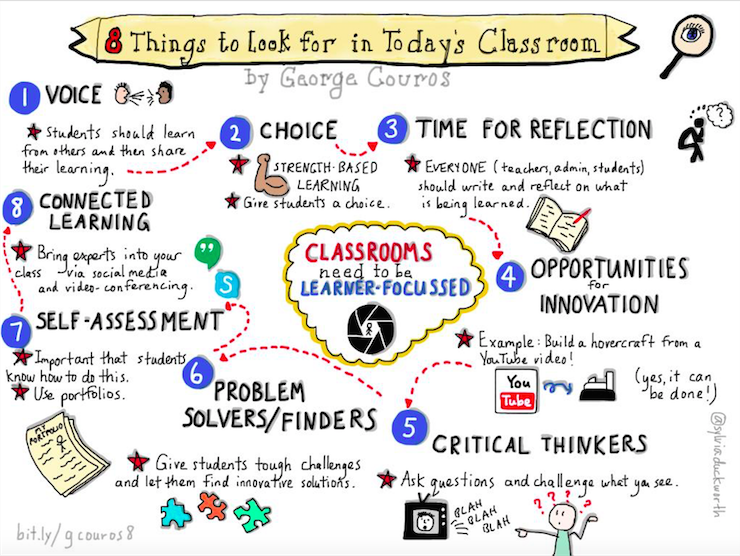
When I say climate change, I’m talking about the shift in thinking in education, particularly toward innovation and creativity.  I’ve seen more marshmallow towers on Twitter in the past 3 months than in the past 3 years.  Districts are discussing blended learning, 4 C's,  and mindsets (fixed vs growth, Innovator’s Mindset) as much as outcomes and assessment indicators.  We are collectively talking about learning spaces and flexible seating as influencers in our students’ learning.  The Innovator’s Mindset (George Couros) should be required reading for every new and veteran teacher alike, and Sylvia Duckworth's sketchnotes should be hanging in the halls of every school.  Her Sketchnote below captures a bit of George Couros's thinking about a learner-focused classroom, and what to look for in today’s classrooms.


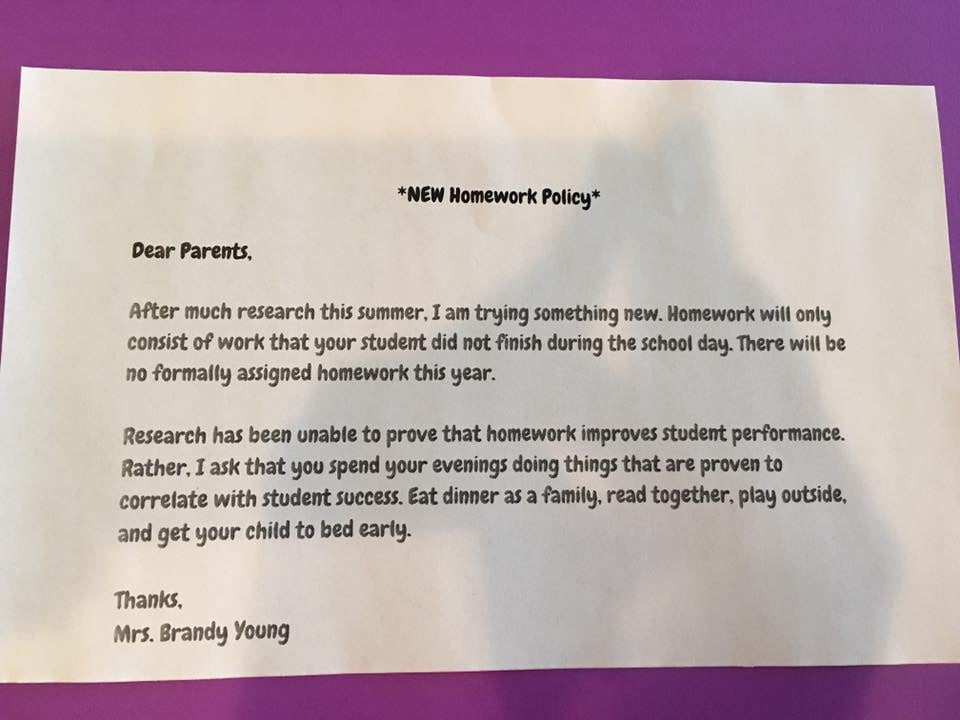
Consider Mrs. Brandy Young’s parent note about homework.  It seemed to come at just the right time to kickstart conversation among parents, teachers and administrators as to how we ask students (and their parents) to spend out-of-school time.  This is climate change, growth mindedness, and the spark of innovation.  There may be no perfect answer, but the discussion is where it’s at!


- Jed