Friday, March 20, 2020

It’s Time to Think Differently About the Way Things Have Always Been Done

😷JedTalks: Home Edition

😱What a difference a week makes. My most recent post talked about that “chasm” we've learned about between the early adopters of innovation in general, or edtech specifically.

😳Well, here we are.  We are ALL in the chasm, overwhelmed, unprepared and unsure of what this is all supposed to look like. We are in various states of remote-learning, extended-learning, distance-teaching, or enrichment. Our edu-world has changed itself. 

😏The common knock that gets thrown around (and rightfully so) is the risk of “changing for the sake of change.”  I think it’s safe to say that all of our recent shifts in our thinking and adjustments to our practice are for the sake of our students. The structures, the schedules, and the tools have changed, but look at what’s stated the same: the commitment to student, families, connection, and learning. 

It’s time to think differently 
about the way things have always been done. 

😬This pandemic is the ultimate equalizer.  We all find ourselves in a state of feeling overwhelmed, unprepared, and out of our comfort zones to access strategies or resources outside our normal instructional skill-sets.  I’ve learned a lot in the past 10 days, at a faster rate than I like, and I bet you have too!

😎Everyone is in the chasm, everyone is unsure of what’s best or what’s next. The best we can do is support ourselves and our families, connect with each other, and connect with families to support their kids first, and support learning second. I’ve been amazed and impressed by how many colleagues have already taken broader steps in the past few days than they have all year, through peer collaboration and district expectation, but more importantly through the need to reach their students. 

😟For educators who have felt reluctant or waited out edtech initiatives, the day has arrived to take the plunge, and my fellow coaches are here to support you! This circumstance is not what any of us have prepared for, but thinking differently about the way we’ve always done things and finding solutions is exactly what we are here for. 

😊No one will do this perfectly, but we will all do what we do best: connect with kids, inspire learning like we always do, and reach out families who find themselves in equally uncharted waters. 


Friday, November 1, 2019

Dash- the Best of the Best in Coding Robots!

Image result for dash robot

There are tons of robots and programmable edtech tools available to kids (and grown-ups) today.  Just watch the holiday commercials ramp up in the next few weeks full of drones and techno-toys.  This post is dedicated to my favorite (and cutest) tool to support computational thinking and coding in school: Dash by Wonder Workshop 

I'm not knocking any other products.  In fact, I've tried most and I like and use each of them for specific purposes.  Beebot and Robot Mouse introduce the idea of giving commands directly to a device: just press directional arrows and go! Botley places those buttons into kids' hands with a simple RF controller.  Ozobot can do a lot, from color-coding with markers to uploading strings of block code!  However, it does get finicky the more it's asked to do. Sphero is super cool, but just a bit too optimistic and advanced for the age of the students I work with. Even Tello Drones continue the programming so that computational thinking can take flight. I even wrote a previous blog post just about drones.  Here's the thing- It's not about the robot.  It's about the student experience in coding, creating, collaborating and problem-solving together that makes each of these experiences so rich.

That's where Dash comes in.  This programmable robot does what I want and need all the others to do in one blinking, dancing, and burping body.  Dash fits well in sequence with these other robots or coding tools. Programming in their Blockly app creates a strong opportunity to apply skills they already know, explore accessible extension to transfer understanding, and gain exposure to features beyond their current scope.
I am a strong believer of bringing the 4 Cs to life in our classrooms. Communication, collaboration, creativity, and critical thinking are all on display when students work together to create and run programs, and even more so when they need to tweak, debug, and revise their code.  This is when the often invisible 5th C: Computational Thinking becomes visible.  It also allows for the clear distinction between the planning, plotting, talking, and problem solving of computational thinking and the drag and drop, programming, and sequencing of actually coding the robot.

I will admit.  I skipped Dash for other robots for a year or two because I thought it looked too basic or reminded me of a Fisher Price toy.  It wasn't until I visited Medfield middle schoolers doing awesome thinks (thanks @kcowell7) that I realized my misjudgment.  Dash isn't cheap at around $150, but worth every dollar, and super durable.  It's absolutely true that the computational skills at work while programming dash are the same when applying block coding solution in online environments like code.org, but you cannot put a price tag on the level of engagement that erupts from watching a group's robot zip around the room and run its program correctly.

It's Not About the Robot
Day one of Dash is always a bit zany, and kids need to work through the novelty of its awesome moves, dances, and noises.  Pretty quickly though, students get into the process of creating their program or routine.  At that moment, thinking shifts from the operation of the robot to the creation of the program.  For this exact reason, I don't install Wonder Workshops other apps for Dash and Dot.  I stick to Blockly as the singular (and familiar) interface for dragging pieces together for students to create their program.  I explain to students (and teachers) that this choice is what keeps our practice focused on coding/programming rather just remote control "live-driving."  When I talk about shifting our thinking of edtech from products to practices, this is that example in action.

He's Got the Look
Yes, Dash is cute- maybe too cute if it prevents others from taking it seriously.  There is a natural affection for a robot that acts and interacts and I think this is more important than I originally considered.  With other robots (Ozobot/Sphero), I often hear "It wouldn't do..." or "Watch what it does," but with Dash it's always "Watch what I made him do," or "Listen to what she says."  This personification is powerful, and it promotes an emotional engagement and creates and emotional connection.

Robot Teacher?
Just like any other tech tool, there needs to be purpose and application of the technology to impact learning.  Having students program dash to model or reteach content is a fun and powerful example of this. For example, after learning the basics in the first day, asking students to make Dash draw a square create an objective, embeds math thinking, and promotes all 4 Cs if students are to accomplish their goal as a group.  Whether it's tracing masking tape shapes, or recording their voice to make Dash explain equivalent fraction, these tasks create an audience, a purpose and focus for programming, and a measurable outcome in the sense of a performance task.

Seymour Papert talked about low floors for ease of entry/access and high ceilings for room to grow and to reach the needs of high-level users.  Mitch Resnick (MIT/Scratch) adds the notion of wide walls: multiple pathways for learning modes for demonstrating understanding.  Dash hits all of these areas.  It's super intuitive to learn from a 5-7 minute class intro, but also complex enough for kids to really stretch thinking.  In fact, I've never used a tool that promotes the level of autonomous problem solving that I see with kids using Dash.  I'm intentional about only demonstrating a select few commands from each Blockly category so that kids need to explore to find more.  Beyond initial setup/connection, groups figure out their own mistakes, answer their own questions, and solve their own problems- seriously!   This is where a class is able to see and apply critical thinking as the process of problem solving.

Dash Math📋
Here is an activity sheet for a Dash Math lesson.  In this lesson, I hand out rolls of masking tape and ask groups of students to program Dash to model or teach a specific math term or concept.  There are multiple levels for students to self-select their level of complexity. This lesson just began as a handful of vocab cards before becoming a self-leveled menu, but feel free to mix it up with everything from measurement skills (How big is a foot) to geometry (Model a square or triangle), to more broad math concepts or principles (Equivalent fraction, Multiplication).  The idea is that the robot and the program become the tool to demonstrate understanding.  Again- it's not about the robot. 

Sunday, August 18, 2019

Back to School 2019: Teacher of the Year


Being a recognized local, state, or national Teacher of the Year is a distinguished honor. That being said, just about all of us (except my VT TOY sister @SusanKochVT!) won’t be selected as Teacher of the Year, but I recently saw this tweet from @tattedteacher that sparked this blog post:


A-ha! We are each and all the teachers of the year for the students we work with.  We are their teacher of the year.  One thing I love about this shift in mindset is that it focuses on what’s ahead. It’s not about recognizing accomplishments or awarding service. It’s about creating culture and building relationships. 

August Anxiety😬
When setting up and decorating the still-clean classroom, or selecting our best day-1 outfit, we get the same nervous excitement about our first day of school, but it can be easy to lose sight of their first day.  Houdini is often credited with saying that a magician is merely an actor playing the part of a magician. We all know that this couldn’t be further from the truth in education, but we have all seen or worked with teachers who have fallen into that similar trap, spending lots of energy, time, attention, and money to set the scene, when setting the tone might be the higher priority. 🎩

👔Learning Unleashed
I’ve been known to say to my tie-wearing colleagues, “nice leash,” just to bust their chops, but there is actually something to it. We all like to look professional, but I have yet to find a student who takes me more seriously or connects more deeply when I’m dressed to the nines. To stretch the concept further, losing the tie brings about learning unleashed. It also implies a potential energy waiting to burst. De-prioritizing the costume of a teacher and the Pinterest-worthy decorations begins to answer the question, are you more interested in being the teacher or being their teacher?

Image result for teacher of the year
It’s not the outfits, marker boxes, devices, or even the curriculum that sets the tone and starts to create the culture of a classroom.  It’s the experiences that frame learning and opportunities to apply understanding that bring learning to life, and it’s no different for an 9 year old than it is for an 19 year old. 


👩🏼‍🎓In gearing up for the new school year (and new school!), I’m also dropping my daughter for her first year at college. Similar to her older brother, I found some wise advise through the search process. In visiting her school of choice for the first time, the President of Roger Willams Univ. presented the results of a recent Gallup poll of 30,000 recent high school graduates that asked what they were looking for in their college search. Again, the ideas and wishes for learning aren’t all that varied between 9 and 19 year-olds. 


👨🏻‍🏫👩🏼‍🏫 Professors Who Make a Difference
Students are inspired and engaged by educators who demonstrate personal connection, investment and visible passion for their craft. This holds true for just about every teacher I've met too.  We are all inspired by our colleagues and mentors who influence and impact the lives of those around them.

🖐 Hands on Practice
Students need authentic opportunities to apply thinking. This includes opportunities to fail, build and rebuild understanding, whether its digital tools, physical models, or writers’ journals. Demonstrating learning can’t be a once-and-done showcase or line-item checklist. 

🙋🏻‍♂️🙋🏻‍♀️Mentors on Campus
Learners look to each other, and all students benefit from peer relationships that model academic, social, and emotional health. I’m moving to a k-5 building and I can’t wait to involve 5th graders as mentors for younger learners, particularly when in comes to digital citizenship. They carry a credibility that no grown-up can match when it comes to sharing safe practices, online behaviors, and responsible use. 

Campus Involvement 
Students need to feel purposeful and valued. When we provide authentic purposes for engagement and involvement, engagement happens at a new level. 
-engagement, purpose, inclusion

🕵🏽‍♀️👩🏻‍🌾👨‍🍳👨🏻‍💻👨🏾‍🎨👩‍🔬Internship Experiences
While we may not have the same types of internship opportunities as higher ed folks, we can design experiences for students to apply and extend learning beyond their classroom walls. Whether it’s being a resource online for another class, blogging for their class or school, or being part of a “student help-desk” for IT expert help, we can begin to engineer experiences with real audiences, real recipients, and real reasons to...

Preparation for Life After Graduation
We may not be sending our kids right out to the workforce, but that doesn’t stop every student from approaching the end of each school year with bittersweet butterflies about what’s next and their preparedness for next classes, grades or schools. Students hunger for an understanding of what’s next and how the skills and understanding we hope to build serve to support a spiraling structure that counties to climb. 

The hopes and dreams of learning are ageless. We all want to experience the joy of discovery, a sense of purpose, and opportunities to make our mark in the world. This is our gift, to make these hopes and dreams come true in our learning spaces. You are the teacher of the year: their teacher of the year!

Friday, July 5, 2019

Be Edventurous: Choose a Curriculum of Courage

💡Curiosity + 🚀Courage + 📚Curriculum = Edventure
✨Creation + 🚧Curation = 🗺 Treasure Map

"Be Bold and Mighty Forces Will Come to Your Aid"

This Goethe/Basil King line is most known for its use in the music film Almost Famous, and to me it’s about risk-taking and fearlessness. It’s about finding the courage to be adventurous, trusting that help will find it way to you as you need it. Fear or anxiety can be a motivator as much as an inhibitor as long as we can identify what’s got us nervous. A healthy fear of the unknown or anxiety about rolling out an untested idea can inform our practice and make us that much more attuned to detail for reflection afterwards. If we aren’t building, improving, or reiterating strategies, we get stuck in repetition of one-off experiences, no matter how cool they may be. The adventure comes from diving in and immediately considering how to improve the next dive. 


🏇Horse Sense🐎
In this year’s Preakness, the horse Bodexpress bucked his jockey as the race took off. At that moment, there were so many wild, dangerous, or tragic outcomes that could have followed. As it turns out, the horse ran the race without its rider!  He was eventually safely corralled after the race concluded. So what’s the connection?  
Image result for bodexpress horse
Washington Post
If we are quick to assume disaster when the unexpected strikes, we can miss the opportunity for rare moments. Just as twitter lit up with Bodexpress memes and he became a very temporary folk horse-hero, we respond best to surprises that disrupt routines and have an underdog to root for. When a lesson tanks (some always will), when the power goes out, or when the bee flies in the room, we should be ready to run with it, just like Bodexpress did!


Next Top Model

Classrooms that seem to have the most active and engaged learning happening usually have leaders who model what they want to see in students. Mitch Resnick’s Creative Learning Spiral is a strong model for this, characterized by stages of imagine, create, play, share, reflect. Whether it’s launching new curriculum content, or exploring our own creative projects for our classes to watch, if we can demonstrate (even through our own personal modifications or interpretations) the Creative Learning Spiral stages in action, we help to create the environment and showcase the competencies that facilitate the creative process. 

Make Experience, Not Excuses
It can be tempting to avoid the types of innovative learning activities that are (by definition) new and different. Combined with content that may be less comfortable (think Hour of Code as a recurring sidestep for many) and some teachers prefer stick to the routine. How does that help every learner (including the teacher) stretch and grow? Everyone has too much on his or her plate- too many initiatives, demands, reports, and emails.  If it comes from a place of creativity and passion, teachers always find room for magic. Even when objectives and content seem handed down and overwhelming at times, there is opportunity to shape that delivery into experiences that are meaningful, memorable, and measurable. Never let the curriculum get in the way of learning!

Some of the most engaging learning opportunities have no precise manual or script to follow, yet the result can be a unique and memorable shared experience for the teacher and for the learner. Genius-hour, genius day, passion projects and PL are all student-centered and student driven. Yes, it’s harder to plan and prepare for more flexible or open-ended activities, but the level of engagement and student agency is apparent by just watching students work. 


👻Who You Gonna Call?
Be brave enough to face and even vanquish the ghosts that haunt our classrooms and hallways. These aren’t spooky ghosts, but the spectre left behind from previous teachers and administrators. Any educator who has to fill the shoes of his or her predecessor has a tricky task, and it seems that the stronger shadow (for better or for worse) that the previous character cast, the harder it can be to emerge from it. Sometimes it’s easier to establish who we are through the lens of who we aren’t, for students, colleagues, and ourselves. The ghosts in our classrooms may also be of our former selves, our own former teachers, or the teachers that parents wish us to be. Some are friendly and some are scary, but pretending they’re not there is what will haunt us.

Inclusive, Exclusive, Excusive, or Reclusive?
Excusive - Can you think of that colleague who is often making excuses, or self-handicapping (I'm not tech-savvy, etc)? 
Image result for mirrorThis is less about humility, and more from professional or personal insecurity. This educator resists feedback because they know they won’t like what they hear, and avoids any observation or demonstration for fear of scrutiny. The result is usually kids getting short-changed. This teacher avoids risk and change, and falls into “the way it’s always been done,” at the cost of innovation or opportunities for their kids. 

Exclusive - This is more than just the person who guards their privacy. I’m talking about that character who falls into self-promotion over peers or even student performance. There’s a fine line between showcasing student performance and showing off fancy teaching. Pride can be a dangerous and damaging element in our business. We all want to have our efforts recognized by our peers or administrators, but when it starts to look like professionals siding against or apart from each other, nobody shines. 

Reclusive- This character is often stuck, or resistant, to the point that students are deprived of opportunity or access. This is not an indictment on that teacher. In fact, it’s generally a measure of self-protection behind the fear or doubt.  We all have our hermit phases, whether it’s trying out a new unfamiliar initiative, launching a unit or project before it’s quite ready, or playing catch up with endless compliance tasks.  There’s security behind closed doors, but it can be easily habit-forming and distancing. 

Inclusive- This educator finds strength through collaboration, and clarity through communication. It’s not enough to know that collaboration and teamwork enhances everyone on a team, but this person is the connector, the one who facilitates the communication and collaboration. 

Image result for know better do better quote
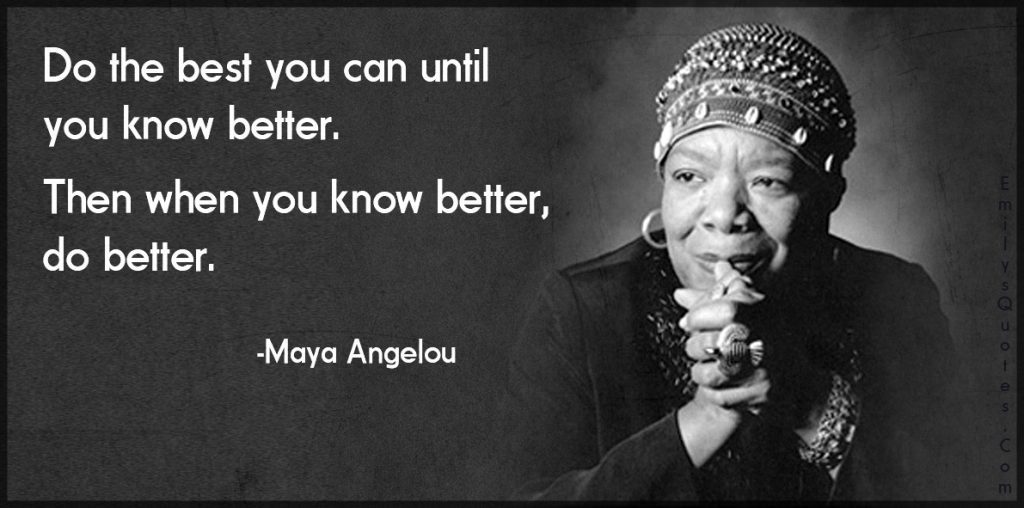
Know Better,  Do better
I love this quote from Maya Angelou. It’s empowering in driving our own growth, while also validating our current practice from a strength/asset mindset, rather than constantly comparing ourselves to others. 
It’s not every teacher’s job to teach him or herself each new initiative, tool, or technique. In fact, the faster the landscape of digital tools and practices evolves, the wider the gap seems to stretch between what has always been done, and what innovative approaches can be integrated to transform teaching and learning. At the same time, we see the rise of edcamps, online learning, and platforms like TPT, where professional development is personalized by the participant. These environments also flip the delivery of pd content, where classroom teachers, the practitioners, become the experts (and some making a decent side-hustle). This is innate coaching, peer to peer, in a shared constructivist model.


Training vs Coaching 
In thinking about my role as a coach, I am deliberate to push away from the title of a trainer.  To me this shift is all about switching from How to Why.  This also directs the encounter from being transactional (service provided) to  relational (facilitating partnership).  As educators, we are aware of the SAMR model (substitution, augmentation, modification, redefinition) as it relates to tech adoption/integration, but I came across this tweet from Joli Boucher that applies the model to coaching, and I think it's awesome! It demonstrates the continuum from a more directive to facilitative approach that promotes partnership and collaboration in professional development, all with the ultimate goal of impact on student learning. My own goal as an instructional coach is to constantly improve and evolve in my capacity to engage, enable, and empower my peers to take risks and seek Edventure!

Friday, June 7, 2019

Theory of Educational Relativity

Is there a secret formula for engaged and effective teaching and learning?

Well, there is one formula that has unlocked some of the answers to life, space, and time as we know it, so this post applies that same formula to the world of teaching and learning. This is my Theory of Educational Relativity.


More specifically (and with apologies to Albert Einstein), this theory expands to become a theory of relativity, as well as relatability and responsibility in our  teaching lives. In looking at the formula, I've swapped a few elements and ideas into the mix. Here goes:

E
Experience
Experience is everything. The experience of our own education is our foundation of how we first encountered teaching and learning. The student-experience is what we are lucky enough to be tasked with creating. We can engineer experience and craft moments that ignite learning. That’s when we witness these other Es: Empowerment, Engagement, Empathy. When these elements come alive, so does learning.

M
Moments
Experience may be everything, but it’s built by moments. Some moments are transformative, while others are also small and personal. If you’ve read my blog before, you know about my 3 Ms that I like to say build those powerful moments. The alchemy is in the intersection of student learning that’s Meaningful, Memorable, and Measurable. A teacher can have a great lesson that hits one of these elements, but when all three intersect- that’s the sweet spot, that’s the magic of moments that ignites learning.


To get back to Einstein, a moment can be considered a point in time and space, so thinking about our building and classrooms, how well (or flexibly) do we approach time and space? What are our variables when it comes to educational time and space? Personalized, Blended, and Flipped learning begin to shift conventional thinking about both components. There’s a reason flexible seating or redesigned learning spaces feel revolutionary, and it’s because they break traditional structures to explore new depth and dimension in student learning.

I don’t mean that we are entering a different dimension in the twilight zone sense, but an increased depth of knowledge, or flexibility in students’ opportunities to show what they know in authentic and meaningful ways. This shift brings emphasis on student competency and understanding over compliance and completion. 

C 
🎶 Somewhere Beyond the Cs 🎶

I’m a big fan of the 4 Cs (communication, collaboration, creativity and critical thinking), but that’s just the start, and since Einstein reminds us that the C is squared, here’s the exponential connection. It’s my belief that those are the “student 4Cs,” while there are additional 4Cs (school 4Cs). These are Culture, Compassion, Connection, Climate. 


If we want our students to experience learning through their Cs, our buildings and classrooms should function to provide learning environments that actively foster and promote culture, compassion, connection, and climate. That’s where empowerment and empathy emerge, and that’s where student agency begins.

While we may not be unlocking the secrets of the universe, I hope this post can serve to shift thinking about our own relativity (the perceptions and perspective we bring), relatability (the connections and relationships we create), and responsibility (the opportunity we face to impact a student’s learning trajectory and their experience of learning). We escape the black holes that distract us or keep us from our forward progress, and avoid the wormholes of time when we catch ourselves doing or saying the exact things our own teachers said to us! Teaching in the moment may not be rocket science, but sometimes it feels like it. When we can bring Einstein's equation to life in our own classrooms and building, time can stand still, and learning  happens at the speed  of life.

Sunday, March 10, 2019

How Does Your Garden Grow?


How Does Your Garden Grow?

Image result for garden
pixabay
With a fresh foot of snow still on the ground, it may not be the easiest time to visualize thriving gardens, but this post isn’t about our backyard crops. It’s about cultivating growth in our learning spaces. We can’t control the weather, but we can condition soil, protect our plants, encourage growth and reap harvests. And just like avid gardeners share and compare their tips for establishing and maintaining healthy gardens, this post looks to lessons from gardeners to help our classroom gardens grow. 

Signs of Life...
Image result for wet rocks
pixabay
In his book Watering Rocks, Dave Maurer cautions against “watering rocks.”  Maurer explains his leadership advice by advising, “Don’t spend too much time trying to fix something that you can’t fix.” 

While it may seem like a bit of a harsh metaphor, I’ve received that exact advice in my coaching role. It’s a warning to not exhaust your own resources with some “at the expense of your superstars.” I will admit, I have mixed feelings about Maurer’s advice. While I understand the idea of leveraging time and attention where it’s most impactful and welcome, I don’t think there are many “rocks” in our profession.  It worth mentioning, any stroll along a river’s edge or shady forest will also prove that nature finds a way to provide growth even on the roughest rocks. 

At the other end of the spectrum is Julie Wilson's description of growing bamboo. In her book, The Human Side of Changing Education: How to Lead Change With Clarity, Conviction, and Courage, she explains:


Image result for bamboo
maxpixel
It takes approximately three to four years for a young bamboo plant to establish a large a solid root structure underground before it starts growing significantly above ground. It would appear that not a lot is happening for a long period of time. But, after three to four years of consistent watering and care, that very same plant can grow several feet overnight. This work if changing the education system is just like the bamboo growth; it require patience and time- and it also requires faith.

This speaks my language more than the the rocks metaphor. It’s a living model of a growth mindset. There's a difference in belief, purpose, expectation, and understanding.  Wilson's book and message is all about effective leadership through compassion and courage, rather than control and compliance, certainly the right environment to cultivate healthy growth.  

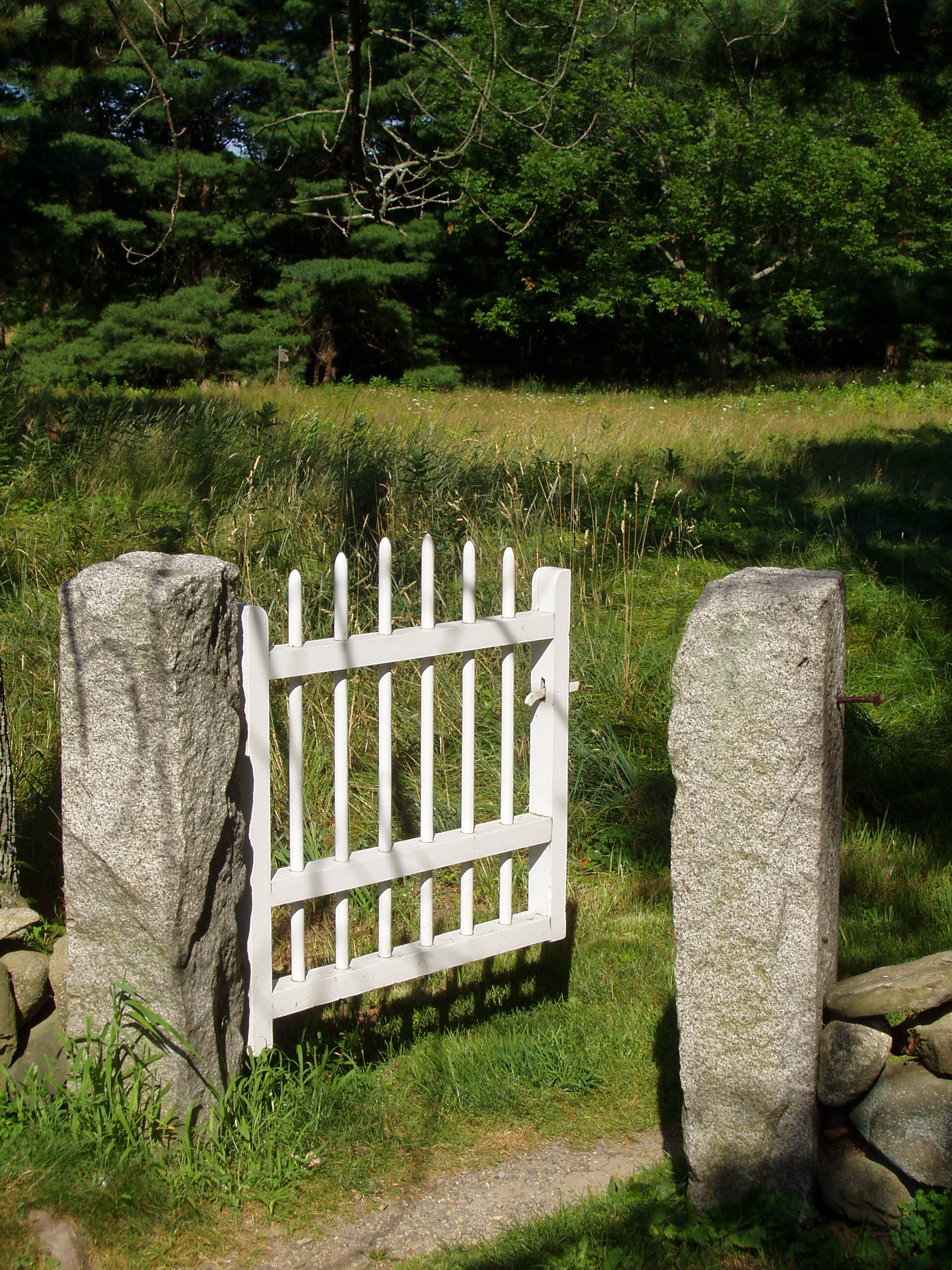
Beyond the Garden Gates...
Image result for garden gates
wikipedia commons
Nature provides sunlight, soil and rain, but these are only the basics. To stretch the metaphor, our schools provide curriculum, stocked classrooms, and the tools to teach and learn. But who carries the water? These who are the cultivators, providers, nurturers all in service of growth. They don’t mind getting hands dirty, literally at ground level cultivating, weeding, and dependably watering. 

Any search for gardening tips yield list after list of recommendations and “Top 10” tips. The first search hits featured guidelines from Growingagreener world.com,  Fine Gardening, and The University of Minnesota Extension. The following topics titles (and quoted passages) are taken straight from their links.

🌱 Test Soil  
The University of Minnesota Extension explains that, "Soil is a living ecosystem—a large community of living organisms linked together through nutrient cycles and energy flows." 
The better we understand our students and their unique needs, the better we can tend to their growth. 

🍃 Add Organic Material/Provide Nutrients 
Our education nutrients are that mixture of curriculum and instruction that promotes and cultivates growth. Our professional craft mixes and maintains the continued balance of nutrients to promote learning and growth. 

🍂 Keep it Covered
A critical component of our job is to create an environment that is safe and encourages new growth. Providing a “protective layer” allows us to conserve the resources that support healthy learning while sheltering from some of the more unwelcome environmental influences. 

💧 Apply the Correct Fertilizer
     Don’t overfertilize
 Just like there will always be new techniques, products, or tools to help tend to our classroom gardens, there’s no such thing as educational Miracle-Gro.  Growth rates are unique among every plant and we shouldn’t expect anything otherwise. Applying the correct fertilizer is all about selecting best practices, effective strategies and appropriate resources to support learning and “stimulate growth.”

⥁ Rotate Crops
Experienced gardeners rotate crops to allow species to share resources and nutrients. Placement, grouping and rotation respect and benefit from a diversity of crops and their unique nutrient requirements. The most effective flexible learning environments rely upon similar benefits!

🌞 Don’t crowd plants
Consider flexible learning spaces.  Thriving gardens allow room to grow, including the parts of the plant you can see and those that may be hidden beneath the soil. The same goes for our learners!


Soil compaction and disturbance such as  tillage can eliminate these important microenvironments. This makes it hard for plant roots to penetrate the soil, absorb water and nutrients, and interact with beneficial microbes.

Disturbing soil also disturbs weed seeds, exposing them to light and increasing germination—in other words, more weeds! (extension.umn.edu)

🐛 Keep an Eye on your Bugs 
      Use Patience with Pest Control


Enough said...

💦 Water Wisely
Finally, Fine Gardening says it best: Also remember that more isn’t necessarily better when giving your plants a drink.


🐝
Don’t forget our pollinators. These are the often unseen, but critical, visitors who provide the fertilization, nutrients and supports that strengthen and reinforce steady and measurable growth. Whether we are the home gardener, the buzzing pollinator, or the busy worker tending to field after field of others gardeners’ crops, we all know our job isn’t about the harvest or yeild. We can learn (or even measure) from what our students produce, but just like gardeners tend to their soil and crops through days, weeks, and seasons, educators are in it for the long haul. We have our own growth measures that can only come with daily care and routine tending, noticing (and responding to) subtle signs of stress or capitalizing on rapid growth opportunities. 


Wednesday, November 14, 2018

Working With a Cast of Characters


Image result for seinfeld
It's not that everything I learned comes from Seinfeld, but there is definitely a Seinfeld story, reference, or character for most occasions.  This has been the most entertaining post yet, recalling all of the ridiculous scenes and sayings.  It’s the characters that this blog post is about.  Besides your students, who surrounds you in your professional life?  Who’s your Kramer, barging in with zany ideas, and who’s your George, requiring more attention and effort than you often have patience to give?  And of course, who’s your Newman?

Image result for seinfeld jerry


Jerry Seinfeld is the ultimate observer. He observes, muses, and criticizes every bit of his life and surroundings.  As a comedian, His professional life is isolating, but his daily life is consumed with a constant traffic flow, often ridiculous interruptions, and cast of even more ridiculous characters. Can you identify?

Image result for elaine push seinfeld

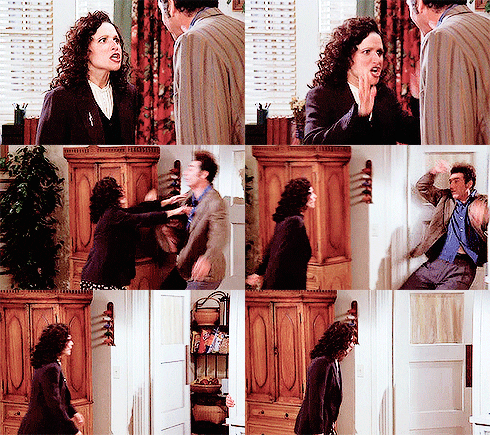
Elaine is the consummate teammate. She will do anything for her friends, but isn’t afraid to push back- literally. She is a challenger without being discouraging. Elaine is comfortable in her own skin (you may recall the dance), brutally honest,  and endlessly patient with her friends’ antics. Every PLC could use a dose of Elaine to keep things real. 

Related imageKramer is a dreamer and an innovator. Who else would install a garbage disposer in the bathtub?  When we talk about designing flexible space, Kramer takes the cake. Remember his hot tub apartment installation, or his his Merv Griffin talk show set? Kramer is an artist and a designer, from his fusilli-pasta sculptures to coffee-table book about... coffee-tables!  Then there is also the fact that most of his schemes are totally crazy, but he believes. That is an innovator’s mindset after all and every school or classroom could use his a little Kramer mojo!

Image result for seinfeldGeorge is the face of a fixed mindset. George has firm opinions and views and does not react well to deviation. While George’s go-to pessimism may not be advisable, there is a characteristic of a healthy skepticism that we can all use to evaluate any new situation, initiative, or product that may come our way to be sure it’s in the service of learning. 

Image result for newman seinfeld
His name is Newman.  We know those characters who predictably difficult to collaborate with. We may not have an individual nemesis like Newman, but it’s always helpful to identify (and prepare for) those whose effort may not align with our own.   

Image result for seinfeld soup nazi There's only one Soup Nazi. It’s critical to identify those whose instinct it is to say no and shut us down. When you've been teaching long enough, you learn crafty ways to ask for things! Hopefully nobody is as severe as “The Soup Nazi,” but it always helps to strategize and prepare how to approach asking for something. 

Image result for uncle leo gif seinfeldNo matter what the occasion or mood, Jerry always has a warm greeting for his Uncle Leo.  It’s a great reminder to set the tone and acknowledge or welcome whoever walks through your classroom or office door with a warm "Hello!" 

Image result for mr costanza seinfeldMr. Costanza is extreme. He is loud and shares every bold idea, but he is also charismatic and creative (he invented a holiday, after all). In our classrooms or offices, Frank serves to remind us that elevating the tone, raising the voice, or intensifying the mood never helps to resolve conflict. 

Image result for mrs costanza seinfeldMrs. Costanza keeps Frank in check. While she can escalate any situation in an instant, Estelle capably deflects or returns his zaniness, and makes her voice heard!  There always needs to be a balance of strong opinions to maintain a dialogue.

Image result for seinfeld bania gif
Kenny Bania is comically optimistic. He is the character that sees “gold, jerry” in any material. While his judgement is questionable, his enthusiasm wins the day and models attitude over aptitude when necessary. Sometimes we all just need that cheerleader who tells us our ideas are gold.

Image result for seinfeld petermanJ Peterman is full of himself and clueless, but somehow innocently, and wildly successful. He has no sense of the work others do in service of his position. We see these characters and remember to never lose focus on the service of learning, or why we got into this business in the first place- for them, not us!

FDR is the ultimate grudge. Kramer’s toxic and timeless grudge with Franklin Delano Romanowski (over receiving the evil eye) serves as a cautionary tale to let go of old bias, gripes, or differences before they turn into epic battles. 

Bob Cobb: he desperately wanted to be called “Maestro.” He is the ultimate example of someone who cares way too much about his title. We have heard it before: Leadership is action, not position. The Maestro would serve to get over himself and pay attention to those around him. I hope this doesn’t sound too familiar!

Jimmy was a pretty brief character, but memorable because he always referred to himself in the third person. While this is awkward and always distancing in a classroom, it also calls to mind the need for perspective. Sometimes we need to step outside of ourselves and our situation for an objective view. Just don’t be the narrate what you see!

Seinfeld, Jack Klompus
Jack Klompus is another extreme personality. He is a neighbor/acquaintance/antagonist of Jerry’s parents and equal parts judgemental and short-tempered.  Jack is the example of finding misguided value and over-attachment to old ways and physical things (Astronaut pen? Cadillac?) to the point of resentment and damage to people and relationships.  Jack is another reminder to let go of the little things.   

Seinfeld, Judge Reinhold
Aaron spoke softly, but closely! Proxemics refers to our interpersonal space and physical closeness. Nobody models the discomfort of that space invasion like the “close talker.” We all know those students (or staff) who just don't seem to have that natural sense of space, and you can feel it instantly.  

Lloyd Braun shows there’s always someone to compete with.  Regardless of his character, personality, or even mental health, Lloyd Braun was always Mrs. Costanza’s model for how George should act and behave. Consequently, George could never shake the shadow of self-judgement against Lloyd.  Serenity now!

Image result for seinfeld puddyPuddy- Sometimes you just can’t judge a book by its cover, but then sometimes you can. I suppose Elaine saw something in David Puddy that made her crew put up with him.  He reminds us to try our best to trust the judgement of those we trust, even when we have doubt! 


This post was inspired by an awesome session I attended at the ETT conference by Dr. Beth Holland and David Quinn in which we were all reminded that "we are all Martys and we are all Georges." Thank you Beth and David!


**All characters and photos from Seinfeld, NBC-Universal


T