Monday, June 1, 2020

😷🦠 Remote Educator's Alphabet


🦠😷Remote Educator's Alphabet 🦠😷

A
🕰Asynchronous- I think this is one of those words that been used in theory more than practice until this pandemic. Now we are understanding the benefit, challenge, and necessity in offering student-paced access and opportunity to learn. 

🎧Airpods- Cut the cord!  While I knew earbuds or headphones make a significant difference on both sides, I hadn’t realized how much more comfortable and natural a wireless Bluetooth pair of earbuds or AirPods would be. Not tethering to a device can shift screentime and videoconferences from a lean-forward to a lean-back activity.

B 
📳Bandwidth-As a parent of a 17, 19, and 20 year old, I am critically aware of the limits of bandwidth. I’m suddenly perfectly comfortable with the home-bound college students sleeping until noon!

💻Blended- While I have long advocated and worked to shift toward a blended learning model with my colleagues, remote/distance/online learning is not blended learning, nor does it or should solely rely on technology. As always, technology is the tool we use to elevate instruction while still offering personal connections and individualized instruction. 

C 
🤳Coaches- Now is the time to lean on instructional coaches. We know and connect the content, the kids, the tools, and the users.  As the landscape continues to evolve, coaches are here to help all staff grow and adapt to equally (and rapidly) evolving needs and demands.

🤷🏼‍♂️Comfort Zone- We all need to breathe.  Whatever our roles, we are all learning more and at a faster rate than we would prefer, but flexibility and a growth mindset can expand comfort zones. Discomfort breeds innovation and I have seen more creative innovation, adaptation, and problem solving among staff members across the tech-readiness spectrum in the past few months than in the last few years!

D 
🔐Digital Divide  More than ever, the digital divide and issues of equity are in the spotlight, with students paying the price and lost in the shadows. its critical that districts and administrators recognize and evaluate shortcomings or limitations that are only perpetuating inequities an access and opportunity for or most vulnerable learners. 

👩🏻‍💻Digital Disposition- It has been critical to expand our own digital dispositions and attitudes toward academic, social, and professional technology to be able to navigate life in quarantine!  As the sage mystic Neal Sonnenberg so wisely stated, "You can't hide anymore."

E 
🧗🏽‍♀️Expectations - Now is the time to shift (not lower) expectations. While our distance learning has upended the look of teaching and learning, it has also created opportunities to engage students in ways that are new for all sides. Just like in our buildings, we need to explore creative ways maintain student engagement to keep learning alive. 

F 
🎬Flipgrid- The free and easy solution to students creating and sharing video content. Whether it’s book talks, reflections, or just riddles of the day, Flipgrid has become a go-to platform for students and teachers to make voices heard- even remotely!

🧬Fauci- This guy! Talk about an emerging voice and subject-matter expert!

G 
💻Google, Google, Google- Classroom, Slides, Meet, you name it. Google has the right tool for the job again and again, and constantly tweaking and rolling out improvements that our situation demand. 

📽Grid View- In Zoom or Meet, we are reminded through grid view the importance of face to face, especially among classmates!

H 
🔗Hyperlinks- Whether it’s a Zoom link, a Google Classroom assignment, or a hyperdoc loaded with links, the hyperlink is the quickly overlooked MVP for placing content and communication one click away for our students and families. 

I 
🎞Instructional Videos- I have never watched more tutorials or instructional videos than I have in the past few months. I know my learning style, and a clear concise tutorial always does the trick. And with tools like Screencastify, teachers (and students) have the tools to create their own tutorials for best practices as well! Our students watch YouTube tutorials night and day, so for a remote learning assignment, Why not transfer some how-to or informational writing skills Into video tutorials on whatever skill or topic kids choose?

J 
😎JedTalks- shameless plug: check out some posts from the archives!

🤳Jigspace If you have not seen this app, it’s a mind-blower for dipping toes into the world of AR (augmented reality) and considering its reach into classrooms. 

K 
👍Kulowiec- If you have a chance to be a part of an in-person or virtual workshop with Greg Kulowiec, buckle up: you will learn a lot- and fast!

👬Kids- Never out of site or out of mind.  They are the reason we got into this business, and though their faces may be in one inch video squares, they need us as much as ever to be present, no matter what that looks like.

L 
🕵🏽‍♀️Learning- Yes, the first few weeks were about shifting and survival, treading water while assessing and addressing connectivity and figuring out just what this might all look like, but student learning never left our focus or central mission. We just had to adapt and adjust our ability to provide a continuity of learning through different modes. 

M 
🗓Menus- It’s about choice. Whether it’s choice boards or activity menus, allowing choice and voice through personalized (and asynchronous) learning experiences, educators are finding new and powerful ways to meet kids where they are and shared the driving. 

N 
✏️Nickname- If you are a google meet user, you know the magic of the Nickname feature. I have my personalized nickname that district users can just use to join right from meet or their gmail window to join meetings or access me in seconds!

O 
🛠Online Learning Manipulatives- This site is exactly what it says. It’s the right tool for the job when looking for clear digital tools to visualize learning tools and practices. 

🚪Office hours- I offer daily office hours for drop-in tech support, troubleshooting, or coaching sessions. It’s comparable to those drive-by hallway encounters where a surprising amount of coaching can occur!

P 
⏰Pace- As teachers, parents, and learners ourselves, our worlds have slowed down and spread out. After schools sports, enrichment clubs and activities have evaporated and students school-days have taken on a whole new pace. When all the dust settles, let’s hope we bring some of this flexibility and openness toward shifted learning time and space back to our buildings and districts. 

📍Platforms- Padlet, Wakelet, Flipgrid, Google Classroom, Seesaw: Platforms like these have made remote learning possible, or at least provided a structure to meet the needs of learners, give voice to ideas, and make learning visible in a virtual learning environment. 

Q 
🎥Quik-  If you don’t know this App, Quik (made by Gopro) is an instant Photo/video Compiler and editor that Can be a powerful tool to collect, compile and share media across platforms. 

🔐Quarantine- Now this a word I never thought would intersect with either my personal or professional life, and now it’s part of our shared vocabulary and experience. 

R 
🤔Reflection- Reflection on practice, equity, and impact is always critical and now is no different. If educators, administrators, and district don’t reflect and closely examine the practices that have been able to be let go along with those that have emerged, we have missed the unexpected opportunity to hold a hard mirror to evaluate existing structures and practices.

S 
🎨Seesaw- I have always thought seesaw was an incredibly powerful tool with capacity to empower our youngest to show what they know and capture learning. Yes, it took a pandemic to turn the tide on some of the more reluctant colleagues, but it has become the preferred companion resource for google classroom to be the one stop platform for content collection, communication, and creation.

T 
🧩Troubleshoot/Tech help- Some days I bum about the amount of tech help vs. teaching help I’m providing through my coaching position, but I remind myself that everyone is maxed out and sometimes the small solutions are the teaching help that’s needed to unlock or enable the teaching practice that follows. 

😳Toilet Paper- Who knew?

U 
🤯Unexpected & Unprepared- That pretty much sums it up. Hopefully this summer schools and districts can put together the training we wish had been in place before remote learning began. 

📲Updates
- It has been impressive to see how products and companies have adapted and updated to meet the constantly evolving needs of the remote educators and learners.
   

V 
🖥Videoconferencing- Whether it's Zoom or Meet, the virtual meeting space has become the learning and "classroom" environment of the day.  It has been inspiring to watch how educators have shifted from the early class meetings in almost crisis-response mode to effective content delivery, with small meetings, breakouts, and 1:1 support.  It's been interesting to me how differently I'm able to approach a coaching conversation across shared screens and virtual space.

🌉Virtual Backgrounds- Yup, I love them.  My current favorite backgrounds are Seinfeld's kitchen, Superman's fortress of solitude, and the street set from Northern Exposure.

W 
🎆Wonderopolis- This site is an endless resource for daily wonders: stories and articles about very interesting things. Great launch pad for reading and writing activities across content and grades. 

🏫Wide Open School- This powerful site from Common Sense Media is a one-stop shop for any parent, provider or educator looking to supplement and support student learning with organized, vetted, and curated content across academic, arts, and social-emotional spheres. 

X 
💠XR (Extended Reality). This broad term applies to AR/VR and any tech-enhanced or virtual environment.  While stuck at home, it's a great chance to learn more about Augmented Reality (AR), the layering of interactive digital images or content over our real view.  Any player of Pokemon GO is already a skilled navigator of an AR world.  JigSpace is a great mobile app to get your AR feet wet!  

Y 
📺Youtube- The internet's ultimate training tool!  With the unavailability of many services during this shutdown, you tube tutorials remind us how learning is a lifelong skill, and they empower us to develop and grow our own skill set, whether it's replacing a kitchen faucet, designing google classroom assessments, or cooking fired rice!

Z 
🌠Zoom. As the zoom vs meet battle royals wages, we have become skilled users of a product hardly any of us even heard of weeks a few short weeks ago.  Just imagine what this experience would be like without videoconferencing capability.

😴ZZZs- I don’t know about you, but catching heavy ZZZs has been challenging. Weird dreams, distracted sleep, and upended routines are affecting everyone’s sleep patterns. 


What did I miss?  Feel free to share you own go-to or game changer!


Friday, May 15, 2020

Giving Straight A's During a Pandemic!


Giving Straight A's During a Pandemic!  
Now that I've got your attention, let me clarify.  This has nothing to do with student-grades.  These Straight A's are about our practice as educators as we manage this rapid, unexpected, and unprepared launch into distance/remote learning: Address-Adapt-Adjust-Assess.  At the moment, we are all somewhere between crisis response, treading water, and managing instruction.  This post is meant to showcase steps we can take to maintain focus on teaching and learning, while also maintaining motivation for ourselves and students: Address needs and equity concerns, Adapt instruction, pace and space, Adjust practices and expectations, and Assess impact and learning,
First we need to recognize that these components can't all happen at once.  As we phase our way through remote learning, the cycle continues and repeats. As educators, coaches, specialists, or administrators, we need to let our learning from each phase inform the next.  Lean on your coaches- it's what we're here for!


Address Needs and Equity
Now more than ever, a personalized approach to meeting the needs of all learners is essential, beginning with access, and not just through Zoom.  Making sure kids are able to connect technologically is only one piece, and it's a near meaningless piece if they aren't connected emotionally.  It has become abundantly clear that supporting students and learning doesn't end at the classroom door anymore.

Adapt Instruction, Pace & Space
It's an understatement to say that educators have had to shift their instruction. Every educator has had their world upended and had to learn more (and faster) than they would ever choose.  That being said, powerful opportunities for growth, collaboration and evolution/revolution have emerged.  Teachers are finding new ways every day to meet the needs of their learners, deliver content, and engage students, whether it's small video-conferences, shared docs/slides, or new edtech tools to allow students to show what they know from home. Every teacher had become a learner.  Every digital learning coach I know has become very popular all of a sudden, particularly with the unfamiliar faces!

Adjust Practice and Expectations
Beyond adapting to new instructional model, platform, pace, and space (as if that's not enough), educators, coaches and administrators are in uncharted waters with new navigational tools on one hand, but we all still know what effective and impactful teaching and learning can look and feel like.  Remote learning doesn't call for the replication of the classroom experience in the sense of schedules or structures, but it does amplify the need to remain connected, build community, and maintain an environment of learning, even if that's a virtual environment that can seem overwhelming at first.  Setting the tone for a continuity of learning is the best first step toward establishing a virtual learning community.

Assess Impact and Learning
This remote learning experience has turned teaching and learning-upside down and inside-out.  Educators have had to explore new ways to package or repackage and deliver (sometimes physically) content, and engage students in ways we've never imagined.  Once we begin move beyond the initial crisis response or management mode, we are seeing the types of student engagement, learning experiences, and student production that are more creative, authentic, and meaningful.  When the dust settles, hopefully we can use this opportunity to reflect on the methods and mechanisms we have discover to capture and showcase student learning, let go of specific practices or traditional structures that may not have been as critical as we believed, and closely evaluate the full impact from each phase of the Address-Adapt-Adjust-Assess cycle.  This impact should be assessed as it would if we were in our brick and mortar word:  how it as affected our ability to deliver content, students' ability to access and respond to instruction in ways that demonstrate knowledge and understanding effectively and meaningfully, and the social-emotional health and well being of our learners.

How about it?  Doesn't every student deserve these Straight A's now and always?


Friday, March 20, 2020

It’s Time to Think Differently About the Way Things Have Always Been Done

😷JedTalks: Home Edition

😱What a difference a week makes. My most recent post talked about that “chasm” we've learned about between the early adopters of innovation in general, or edtech specifically.

😳Well, here we are.  We are ALL in the chasm, overwhelmed, unprepared and unsure of what this is all supposed to look like. We are in various states of remote-learning, extended-learning, distance-teaching, or enrichment. Our edu-world has changed itself. 

😏The common knock that gets thrown around (and rightfully so) is the risk of “changing for the sake of change.”  I think it’s safe to say that all of our recent shifts in our thinking and adjustments to our practice are for the sake of our students. The structures, the schedules, and the tools have changed, but look at what’s stated the same: the commitment to student, families, connection, and learning. 

It’s time to think differently 
about the way things have always been done. 

😬This pandemic is the ultimate equalizer.  We all find ourselves in a state of feeling overwhelmed, unprepared, and out of our comfort zones to access strategies or resources outside our normal instructional skill-sets.  I’ve learned a lot in the past 10 days, at a faster rate than I like, and I bet you have too!

😎Everyone is in the chasm, everyone is unsure of what’s best or what’s next. The best we can do is support ourselves and our families, connect with each other, and connect with families to support their kids first, and support learning second. I’ve been amazed and impressed by how many colleagues have already taken broader steps in the past few days than they have all year, through peer collaboration and district expectation, but more importantly through the need to reach their students. 

😟For educators who have felt reluctant or waited out edtech initiatives, the day has arrived to take the plunge, and my fellow coaches are here to support you! This circumstance is not what any of us have prepared for, but thinking differently about the way we’ve always done things and finding solutions is exactly what we are here for. 

😊No one will do this perfectly, but we will all do what we do best: connect with kids, inspire learning like we always do, and reach out families who find themselves in equally uncharted waters. 


Friday, November 1, 2019

Dash- the Best of the Best in Coding Robots!

Image result for dash robot

There are tons of robots and programmable edtech tools available to kids (and grown-ups) today.  Just watch the holiday commercials ramp up in the next few weeks full of drones and techno-toys.  This post is dedicated to my favorite (and cutest) tool to support computational thinking and coding in school: Dash by Wonder Workshop 

I'm not knocking any other products.  In fact, I've tried most and I like and use each of them for specific purposes.  Beebot and Robot Mouse introduce the idea of giving commands directly to a device: just press directional arrows and go! Botley places those buttons into kids' hands with a simple RF controller.  Ozobot can do a lot, from color-coding with markers to uploading strings of block code!  However, it does get finicky the more it's asked to do. Sphero is super cool, but just a bit too optimistic and advanced for the age of the students I work with. Even Tello Drones continue the programming so that computational thinking can take flight. I even wrote a previous blog post just about drones.  Here's the thing- It's not about the robot.  It's about the student experience in coding, creating, collaborating and problem-solving together that makes each of these experiences so rich.

That's where Dash comes in.  This programmable robot does what I want and need all the others to do in one blinking, dancing, and burping body.  Dash fits well in sequence with these other robots or coding tools. Programming in their Blockly app creates a strong opportunity to apply skills they already know, explore accessible extension to transfer understanding, and gain exposure to features beyond their current scope.
I am a strong believer of bringing the 4 Cs to life in our classrooms. Communication, collaboration, creativity, and critical thinking are all on display when students work together to create and run programs, and even more so when they need to tweak, debug, and revise their code.  This is when the often invisible 5th C: Computational Thinking becomes visible.  It also allows for the clear distinction between the planning, plotting, talking, and problem solving of computational thinking and the drag and drop, programming, and sequencing of actually coding the robot.

I will admit.  I skipped Dash for other robots for a year or two because I thought it looked too basic or reminded me of a Fisher Price toy.  It wasn't until I visited Medfield middle schoolers doing awesome thinks (thanks @kcowell7) that I realized my misjudgment.  Dash isn't cheap at around $150, but worth every dollar, and super durable.  It's absolutely true that the computational skills at work while programming dash are the same when applying block coding solution in online environments like code.org, but you cannot put a price tag on the level of engagement that erupts from watching a group's robot zip around the room and run its program correctly.

It's Not About the Robot
Day one of Dash is always a bit zany, and kids need to work through the novelty of its awesome moves, dances, and noises.  Pretty quickly though, students get into the process of creating their program or routine.  At that moment, thinking shifts from the operation of the robot to the creation of the program.  For this exact reason, I don't install Wonder Workshops other apps for Dash and Dot.  I stick to Blockly as the singular (and familiar) interface for dragging pieces together for students to create their program.  I explain to students (and teachers) that this choice is what keeps our practice focused on coding/programming rather just remote control "live-driving."  When I talk about shifting our thinking of edtech from products to practices, this is that example in action.

He's Got the Look
Yes, Dash is cute- maybe too cute if it prevents others from taking it seriously.  There is a natural affection for a robot that acts and interacts and I think this is more important than I originally considered.  With other robots (Ozobot/Sphero), I often hear "It wouldn't do..." or "Watch what it does," but with Dash it's always "Watch what I made him do," or "Listen to what she says."  This personification is powerful, and it promotes an emotional engagement and creates and emotional connection.

Robot Teacher?
Just like any other tech tool, there needs to be purpose and application of the technology to impact learning.  Having students program dash to model or reteach content is a fun and powerful example of this. For example, after learning the basics in the first day, asking students to make Dash draw a square create an objective, embeds math thinking, and promotes all 4 Cs if students are to accomplish their goal as a group.  Whether it's tracing masking tape shapes, or recording their voice to make Dash explain equivalent fraction, these tasks create an audience, a purpose and focus for programming, and a measurable outcome in the sense of a performance task.

Seymour Papert talked about low floors for ease of entry/access and high ceilings for room to grow and to reach the needs of high-level users.  Mitch Resnick (MIT/Scratch) adds the notion of wide walls: multiple pathways for learning modes for demonstrating understanding.  Dash hits all of these areas.  It's super intuitive to learn from a 5-7 minute class intro, but also complex enough for kids to really stretch thinking.  In fact, I've never used a tool that promotes the level of autonomous problem solving that I see with kids using Dash.  I'm intentional about only demonstrating a select few commands from each Blockly category so that kids need to explore to find more.  Beyond initial setup/connection, groups figure out their own mistakes, answer their own questions, and solve their own problems- seriously!   This is where a class is able to see and apply critical thinking as the process of problem solving.

Dash Math📋
Here is an activity sheet for a Dash Math lesson.  In this lesson, I hand out rolls of masking tape and ask groups of students to program Dash to model or teach a specific math term or concept.  There are multiple levels for students to self-select their level of complexity. This lesson just began as a handful of vocab cards before becoming a self-leveled menu, but feel free to mix it up with everything from measurement skills (How big is a foot) to geometry (Model a square or triangle), to more broad math concepts or principles (Equivalent fraction, Multiplication).  The idea is that the robot and the program become the tool to demonstrate understanding.  Again- it's not about the robot. 

Sunday, August 18, 2019

Back to School 2019: Teacher of the Year


Being a recognized local, state, or national Teacher of the Year is a distinguished honor. That being said, just about all of us (except my VT TOY sister @SusanKochVT!) won’t be selected as Teacher of the Year, but I recently saw this tweet from @tattedteacher that sparked this blog post:


A-ha! We are each and all the teachers of the year for the students we work with.  We are their teacher of the year.  One thing I love about this shift in mindset is that it focuses on what’s ahead. It’s not about recognizing accomplishments or awarding service. It’s about creating culture and building relationships. 

August Anxiety😬
When setting up and decorating the still-clean classroom, or selecting our best day-1 outfit, we get the same nervous excitement about our first day of school, but it can be easy to lose sight of their first day.  Houdini is often credited with saying that a magician is merely an actor playing the part of a magician. We all know that this couldn’t be further from the truth in education, but we have all seen or worked with teachers who have fallen into that similar trap, spending lots of energy, time, attention, and money to set the scene, when setting the tone might be the higher priority. 🎩

👔Learning Unleashed
I’ve been known to say to my tie-wearing colleagues, “nice leash,” just to bust their chops, but there is actually something to it. We all like to look professional, but I have yet to find a student who takes me more seriously or connects more deeply when I’m dressed to the nines. To stretch the concept further, losing the tie brings about learning unleashed. It also implies a potential energy waiting to burst. De-prioritizing the costume of a teacher and the Pinterest-worthy decorations begins to answer the question, are you more interested in being the teacher or being their teacher?

Image result for teacher of the year
It’s not the outfits, marker boxes, devices, or even the curriculum that sets the tone and starts to create the culture of a classroom.  It’s the experiences that frame learning and opportunities to apply understanding that bring learning to life, and it’s no different for an 9 year old than it is for an 19 year old. 


👩🏼‍🎓In gearing up for the new school year (and new school!), I’m also dropping my daughter for her first year at college. Similar to her older brother, I found some wise advise through the search process. In visiting her school of choice for the first time, the President of Roger Willams Univ. presented the results of a recent Gallup poll of 30,000 recent high school graduates that asked what they were looking for in their college search. Again, the ideas and wishes for learning aren’t all that varied between 9 and 19 year-olds. 


👨🏻‍🏫👩🏼‍🏫 Professors Who Make a Difference
Students are inspired and engaged by educators who demonstrate personal connection, investment and visible passion for their craft. This holds true for just about every teacher I've met too.  We are all inspired by our colleagues and mentors who influence and impact the lives of those around them.

🖐 Hands on Practice
Students need authentic opportunities to apply thinking. This includes opportunities to fail, build and rebuild understanding, whether its digital tools, physical models, or writers’ journals. Demonstrating learning can’t be a once-and-done showcase or line-item checklist. 

🙋🏻‍♂️🙋🏻‍♀️Mentors on Campus
Learners look to each other, and all students benefit from peer relationships that model academic, social, and emotional health. I’m moving to a k-5 building and I can’t wait to involve 5th graders as mentors for younger learners, particularly when in comes to digital citizenship. They carry a credibility that no grown-up can match when it comes to sharing safe practices, online behaviors, and responsible use. 

Campus Involvement 
Students need to feel purposeful and valued. When we provide authentic purposes for engagement and involvement, engagement happens at a new level. 
-engagement, purpose, inclusion

🕵🏽‍♀️👩🏻‍🌾👨‍🍳👨🏻‍💻👨🏾‍🎨👩‍🔬Internship Experiences
While we may not have the same types of internship opportunities as higher ed folks, we can design experiences for students to apply and extend learning beyond their classroom walls. Whether it’s being a resource online for another class, blogging for their class or school, or being part of a “student help-desk” for IT expert help, we can begin to engineer experiences with real audiences, real recipients, and real reasons to...

Preparation for Life After Graduation
We may not be sending our kids right out to the workforce, but that doesn’t stop every student from approaching the end of each school year with bittersweet butterflies about what’s next and their preparedness for next classes, grades or schools. Students hunger for an understanding of what’s next and how the skills and understanding we hope to build serve to support a spiraling structure that counties to climb. 

The hopes and dreams of learning are ageless. We all want to experience the joy of discovery, a sense of purpose, and opportunities to make our mark in the world. This is our gift, to make these hopes and dreams come true in our learning spaces. You are the teacher of the year: their teacher of the year!

Friday, July 5, 2019

Be Edventurous: Choose a Curriculum of Courage

💡Curiosity + 🚀Courage + 📚Curriculum = Edventure
✨Creation + 🚧Curation = 🗺 Treasure Map

"Be Bold and Mighty Forces Will Come to Your Aid"

This Goethe/Basil King line is most known for its use in the music film Almost Famous, and to me it’s about risk-taking and fearlessness. It’s about finding the courage to be adventurous, trusting that help will find it way to you as you need it. Fear or anxiety can be a motivator as much as an inhibitor as long as we can identify what’s got us nervous. A healthy fear of the unknown or anxiety about rolling out an untested idea can inform our practice and make us that much more attuned to detail for reflection afterwards. If we aren’t building, improving, or reiterating strategies, we get stuck in repetition of one-off experiences, no matter how cool they may be. The adventure comes from diving in and immediately considering how to improve the next dive. 


🏇Horse Sense🐎
In this year’s Preakness, the horse Bodexpress bucked his jockey as the race took off. At that moment, there were so many wild, dangerous, or tragic outcomes that could have followed. As it turns out, the horse ran the race without its rider!  He was eventually safely corralled after the race concluded. So what’s the connection?  
Image result for bodexpress horse
Washington Post
If we are quick to assume disaster when the unexpected strikes, we can miss the opportunity for rare moments. Just as twitter lit up with Bodexpress memes and he became a very temporary folk horse-hero, we respond best to surprises that disrupt routines and have an underdog to root for. When a lesson tanks (some always will), when the power goes out, or when the bee flies in the room, we should be ready to run with it, just like Bodexpress did!


Next Top Model

Classrooms that seem to have the most active and engaged learning happening usually have leaders who model what they want to see in students. Mitch Resnick’s Creative Learning Spiral is a strong model for this, characterized by stages of imagine, create, play, share, reflect. Whether it’s launching new curriculum content, or exploring our own creative projects for our classes to watch, if we can demonstrate (even through our own personal modifications or interpretations) the Creative Learning Spiral stages in action, we help to create the environment and showcase the competencies that facilitate the creative process. 

Make Experience, Not Excuses
It can be tempting to avoid the types of innovative learning activities that are (by definition) new and different. Combined with content that may be less comfortable (think Hour of Code as a recurring sidestep for many) and some teachers prefer stick to the routine. How does that help every learner (including the teacher) stretch and grow? Everyone has too much on his or her plate- too many initiatives, demands, reports, and emails.  If it comes from a place of creativity and passion, teachers always find room for magic. Even when objectives and content seem handed down and overwhelming at times, there is opportunity to shape that delivery into experiences that are meaningful, memorable, and measurable. Never let the curriculum get in the way of learning!

Some of the most engaging learning opportunities have no precise manual or script to follow, yet the result can be a unique and memorable shared experience for the teacher and for the learner. Genius-hour, genius day, passion projects and PL are all student-centered and student driven. Yes, it’s harder to plan and prepare for more flexible or open-ended activities, but the level of engagement and student agency is apparent by just watching students work. 


👻Who You Gonna Call?
Be brave enough to face and even vanquish the ghosts that haunt our classrooms and hallways. These aren’t spooky ghosts, but the spectre left behind from previous teachers and administrators. Any educator who has to fill the shoes of his or her predecessor has a tricky task, and it seems that the stronger shadow (for better or for worse) that the previous character cast, the harder it can be to emerge from it. Sometimes it’s easier to establish who we are through the lens of who we aren’t, for students, colleagues, and ourselves. The ghosts in our classrooms may also be of our former selves, our own former teachers, or the teachers that parents wish us to be. Some are friendly and some are scary, but pretending they’re not there is what will haunt us.

Inclusive, Exclusive, Excusive, or Reclusive?
Excusive - Can you think of that colleague who is often making excuses, or self-handicapping (I'm not tech-savvy, etc)? 
Image result for mirrorThis is less about humility, and more from professional or personal insecurity. This educator resists feedback because they know they won’t like what they hear, and avoids any observation or demonstration for fear of scrutiny. The result is usually kids getting short-changed. This teacher avoids risk and change, and falls into “the way it’s always been done,” at the cost of innovation or opportunities for their kids. 

Exclusive - This is more than just the person who guards their privacy. I’m talking about that character who falls into self-promotion over peers or even student performance. There’s a fine line between showcasing student performance and showing off fancy teaching. Pride can be a dangerous and damaging element in our business. We all want to have our efforts recognized by our peers or administrators, but when it starts to look like professionals siding against or apart from each other, nobody shines. 

Reclusive- This character is often stuck, or resistant, to the point that students are deprived of opportunity or access. This is not an indictment on that teacher. In fact, it’s generally a measure of self-protection behind the fear or doubt.  We all have our hermit phases, whether it’s trying out a new unfamiliar initiative, launching a unit or project before it’s quite ready, or playing catch up with endless compliance tasks.  There’s security behind closed doors, but it can be easily habit-forming and distancing. 

Inclusive- This educator finds strength through collaboration, and clarity through communication. It’s not enough to know that collaboration and teamwork enhances everyone on a team, but this person is the connector, the one who facilitates the communication and collaboration. 

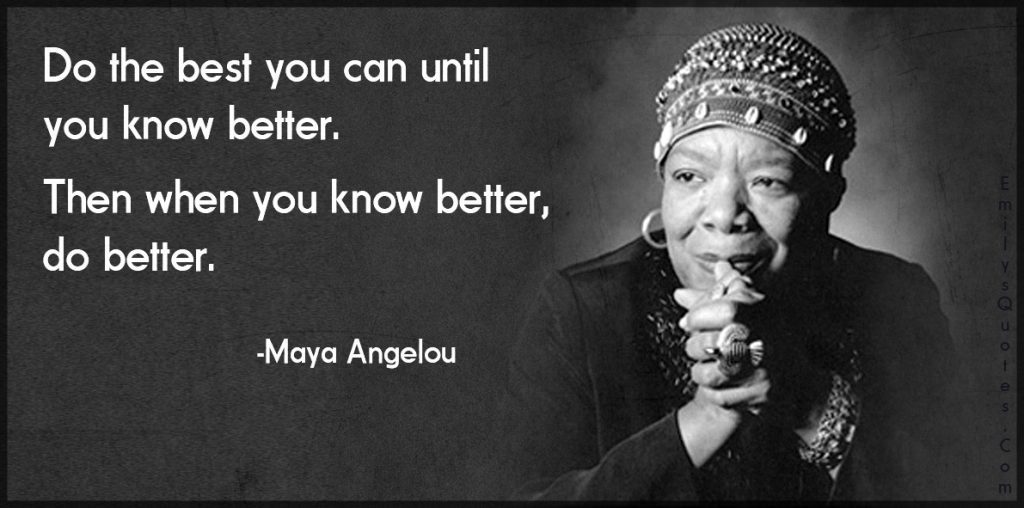
Image result for know better do better quote
Know Better,  Do better
I love this quote from Maya Angelou. It’s empowering in driving our own growth, while also validating our current practice from a strength/asset mindset, rather than constantly comparing ourselves to others. 
It’s not every teacher’s job to teach him or herself each new initiative, tool, or technique. In fact, the faster the landscape of digital tools and practices evolves, the wider the gap seems to stretch between what has always been done, and what innovative approaches can be integrated to transform teaching and learning. At the same time, we see the rise of edcamps, online learning, and platforms like TPT, where professional development is personalized by the participant. These environments also flip the delivery of pd content, where classroom teachers, the practitioners, become the experts (and some making a decent side-hustle). This is innate coaching, peer to peer, in a shared constructivist model.


Training vs Coaching 
In thinking about my role as a coach, I am deliberate to push away from the title of a trainer.  To me this shift is all about switching from How to Why.  This also directs the encounter from being transactional (service provided) to  relational (facilitating partnership).  As educators, we are aware of the SAMR model (substitution, augmentation, modification, redefinition) as it relates to tech adoption/integration, but I came across this tweet from Joli Boucher that applies the model to coaching, and I think it's awesome! It demonstrates the continuum from a more directive to facilitative approach that promotes partnership and collaboration in professional development, all with the ultimate goal of impact on student learning. My own goal as an instructional coach is to constantly improve and evolve in my capacity to engage, enable, and empower my peers to take risks and seek Edventure!

Friday, June 7, 2019

Theory of Educational Relativity

Is there a secret formula for engaged and effective teaching and learning?

Well, there is one formula that has unlocked some of the answers to life, space, and time as we know it, so this post applies that same formula to the world of teaching and learning. This is my Theory of Educational Relativity.


More specifically (and with apologies to Albert Einstein), this theory expands to become a theory of relativity, as well as relatability and responsibility in our  teaching lives. In looking at the formula, I've swapped a few elements and ideas into the mix. Here goes:

E
Experience
Experience is everything. The experience of our own education is our foundation of how we first encountered teaching and learning. The student-experience is what we are lucky enough to be tasked with creating. We can engineer experience and craft moments that ignite learning. That’s when we witness these other Es: Empowerment, Engagement, Empathy. When these elements come alive, so does learning.

M
Moments
Experience may be everything, but it’s built by moments. Some moments are transformative, while others are also small and personal. If you’ve read my blog before, you know about my 3 Ms that I like to say build those powerful moments. The alchemy is in the intersection of student learning that’s Meaningful, Memorable, and Measurable. A teacher can have a great lesson that hits one of these elements, but when all three intersect- that’s the sweet spot, that’s the magic of moments that ignites learning.


To get back to Einstein, a moment can be considered a point in time and space, so thinking about our building and classrooms, how well (or flexibly) do we approach time and space? What are our variables when it comes to educational time and space? Personalized, Blended, and Flipped learning begin to shift conventional thinking about both components. There’s a reason flexible seating or redesigned learning spaces feel revolutionary, and it’s because they break traditional structures to explore new depth and dimension in student learning.

I don’t mean that we are entering a different dimension in the twilight zone sense, but an increased depth of knowledge, or flexibility in students’ opportunities to show what they know in authentic and meaningful ways. This shift brings emphasis on student competency and understanding over compliance and completion. 

C 
🎶 Somewhere Beyond the Cs 🎶

I’m a big fan of the 4 Cs (communication, collaboration, creativity and critical thinking), but that’s just the start, and since Einstein reminds us that the C is squared, here’s the exponential connection. It’s my belief that those are the “student 4Cs,” while there are additional 4Cs (school 4Cs). These are Culture, Compassion, Connection, Climate. 


If we want our students to experience learning through their Cs, our buildings and classrooms should function to provide learning environments that actively foster and promote culture, compassion, connection, and climate. That’s where empowerment and empathy emerge, and that’s where student agency begins.

While we may not be unlocking the secrets of the universe, I hope this post can serve to shift thinking about our own relativity (the perceptions and perspective we bring), relatability (the connections and relationships we create), and responsibility (the opportunity we face to impact a student’s learning trajectory and their experience of learning). We escape the black holes that distract us or keep us from our forward progress, and avoid the wormholes of time when we catch ourselves doing or saying the exact things our own teachers said to us! Teaching in the moment may not be rocket science, but sometimes it feels like it. When we can bring Einstein's equation to life in our own classrooms and building, time can stand still, and learning  happens at the speed  of life.